
Case: French online conversations about declining wine consumption
The subject of the downturn of French wine consumption is not new. This matter has put the French wine industry in difficulty for several years now and there are many reasons behind this reality.
The Quiet Quotient Cultural Research Team has looked at the declining consumption with a new lens. This survey gets deeper in cultural and identity analysis to understand where the new consumers and the old drink stand exactly.
1. Wine is losing its cultural immunity
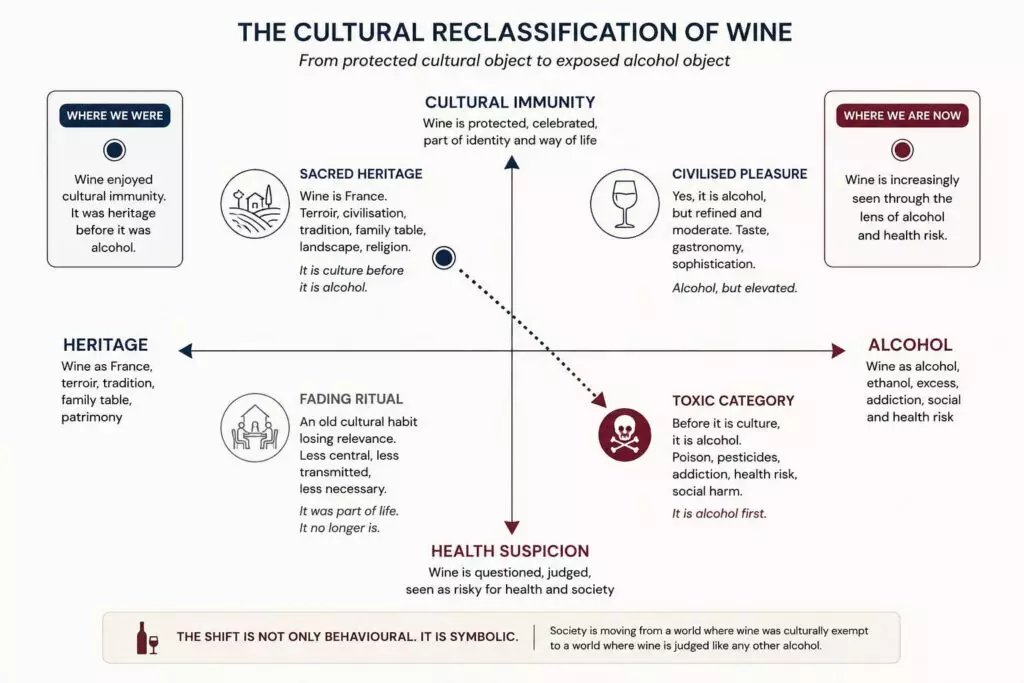
In 2026 it is more or less obvious that people, especially the younger generations are drinking less. However, when we get to the wine industry and try to search for a better answer while looking through cultural aspects, the strongest cultural shift is not simply “people drink less.” It is that wine is increasingly being reclassified from heritage product to alcohol product.
Older cultural code:
Wine = France, table, terroir, civilisation, tradition.
Emerging code:
Wine = alcohol, poison, pesticides, addiction, health risk.
The cultural image of this sophisticated ancient drink has changed.
Evidence appears in comments like:
“L’alcool, même à faible dose est un poison.”
“Les français ont juste cessé d’être des ivrognes.”
“On perd la culture de l’alcoolisme.”
This is culturally powerful because wine historically benefited from symbolic protection. It was not treated like whisky, vodka, or cigarettes. It belonged to the meal, the family table, the landscape, even religion.
Now some consumers are stripping away that symbolic layer. They are saying: before it is culture, before it is terroir, before it is France — it is alcohol.
Strategic implication
The wine industry cannot only defend wine as “culture.” For some consumers, that argument now sounds like denial. The category may need a new legitimacy narrative around moderation, pleasure, craft, ecology, and occasion — not daily cultural entitlement.
2. Wine is being relocated from daily life to exceptional life
Several comments from the survey show that wine is not necessarily rejected; it is being moved.
One comment says:
“Le vin fait partie de mes repas ‘améliorés’, pas de mon quotidien.”
This is a crucial sentence. It means wine has lost frequency.
Culturally, wine is moving from: everyday ritual to: occasional enhancement.
That is a major category-entry-point problem in Byron Sharp terms. If wine loses ordinary occasions, it loses mental availability. People may still “like” wine, but they no longer think of it automatically for daily meals.
Strategic implication
The issue is not only preference. It is occasional erosion. Wine brands need to rebuild simple, modern consumption occasions: light dinner, aperitif, picnic, low-alcohol lunch, casual gifting, streaming night, small bottle formats.
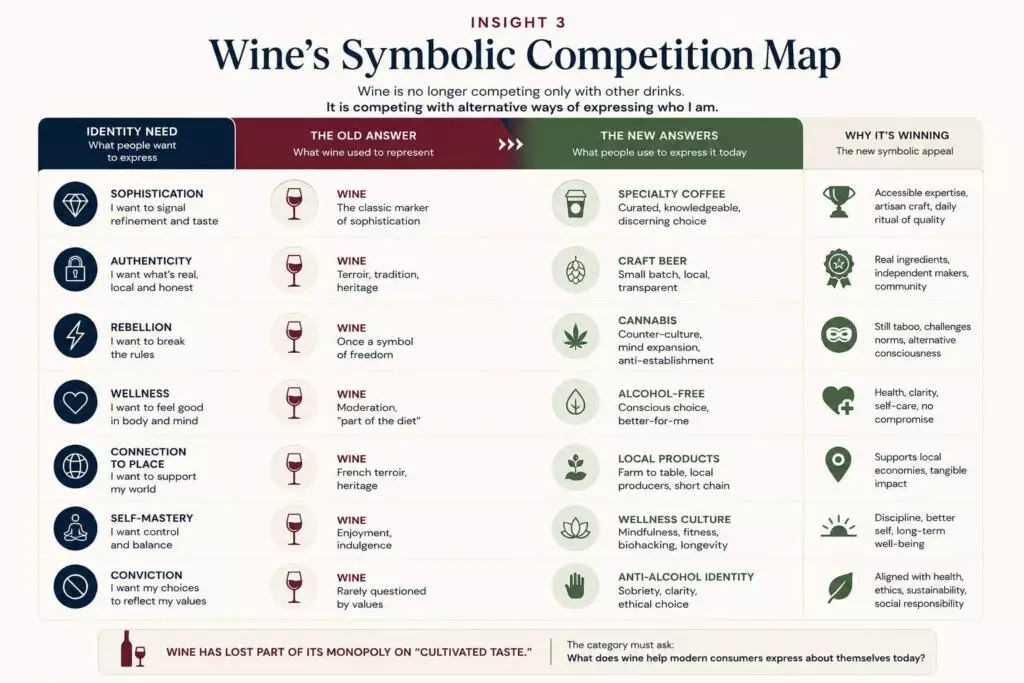
3. Wine’s symbolic competitors are no longer only beverages
A shallow analysis would say wine is losing to beer, spirits, or alcohol-free drinks.
But the data suggests wine is losing to identity systems.
Substitutes include:
- craft beer
- cannabis
- alcohol-free beverages
- wellness
- local products
- anti-alcohol identity
- ecological consciousness
One comment says:
“La tendance est à des vins plus simples, à l’ancienne, naturels et aussi au cannabis.”
This is not just substitution. It is a shift in symbolic attractiveness.
Wine used to signal sophistication. Now sophistication can be signaled through craft beer, natural wine, specialty coffee, wellness, localism, or even abstinence.
Strategic implication
Wine has lost part of its monopoly on “cultivated taste.” The category must ask: what does wine help modern consumers express about themselves today?
4. The category is suffering from cultural complexity
A big number of those who were surveyed confessed that wine is not only expensive; it is difficult. AOP, appellations, terroir, regions, codes, “good” vs “bad” wine — all of this can create symbolic distance.
One comment criticizes the idea that simply putting AOP on a label is enough:
“Une bonne partie de la production n’est plus adaptée au goût du jour et mettre une AOP sur l’étiquette n’y change rien.”
This is important. AOP may reassure insiders, but it may not help outsiders enter the category.
In De Mooij terms, wine is overloaded with cultural codes. These codes create meaning for insiders, but friction for new or younger consumers.
Strategic implication
The industry may need fewer insider codes and more consumer-entry codes: taste, occasion, mood, food pairing, simplicity, confidence, accessibility.
5. The old French wine identity is being morally challenged
Some comments attack not only wine consumption but the wine industry itself:
“ces voyous de viticulteurs”
“rapacité, avidité et cupidité”
“vin pesticide”
“arrêtons de subventionner les agriculteurs.”
This shows a shift from product criticism to moral criticism.
Wine producers are not always seen as guardians of heritage. In some comments, they are framed as:
- subsidy-dependent
- greedy
- ecologically harmful
- resistant to change
- politically protected
This is dangerous because it weakens the emotional contract between consumer and producer.
Strategic implication
The industry needs trust repair, not only product innovation. Transparency, ecological proof, fair pricing, producer humility, and visible adaptation may matter as much as taste.
6. “Tradition” is no longer automatically positive
This is one of the sharpest insights.
Tradition used to be wine’s advantage.
But in the dataset, tradition is sometimes reframed as a liability:
daily drinking
alcoholism
old generations
outdated habits
resistance to change
This is provocative, but analytically important. It shows that “tradition” alone is not a safe brand asset anymore. Modern consumers may ask: which traditions deserve to survive?
Strategic implication
Wine must separate living heritage from dead tradition.
Living heritage:
craft, landscape, skill, conviviality, biodiversity, pleasure.
Dead tradition:
daily alcohol, masculine excess, social pressure, denial of health risk.
That distinction could become a powerful strategic framework.
Possible signature insight
The decline of wine consumption is not only a decline in drinking.
It is a decline in wine’s cultural automaticity.
Wine is no longer automatically:
- the drink of the meal
- the symbol of French refinement
- the default adult beverage
- the unquestioned heritage product
- the superior taste marker
That is the deeper strategic issue.
Not consumption decline. Meaning decline.
Beyond Wine: Understanding Meaning Decline
The decline of wine consumption may not be primarily a consumption problem. It may be a meaning problem.
Our analysis suggests that consumers are not simply drinking less wine. They are assigning wine a different cultural role. A product that once benefited from strong associations with heritage, daily rituals, gastronomy, and national identity is increasingly evaluated through the lenses of health, moderation, individual choice, and alternative lifestyles.
This is precisely why social listening must go beyond mentions, sentiment scores, and trend tracking.
At Quiet Quotient, we combine behavioral analysis, cultural intelligence, social listening, and strategic interpretation to uncover the deeper forces shaping consumer decisions, category growth, and market change.
The most important insights are often not found in what consumers say directly, but in the meanings, tensions, identities, and cultural shifts hidden beneath the surface of public conversations.
If you would like to explore how this methodology can be applied to your category, brand, market, or strategic challenge, we would be delighted to continue the conversation.