why your customers went quiet?
A study published this year found something almost nobody was looking for. Researchers analyzing over two thousand people’s daily conversations, recorded passively over more than a decade, noticed the numbers kept sliding: fewer words spoken, year after year, at a rate too steady to be noise. It wasn’t a fluke. It’s still happening.
That single finding is a useful way into a bigger question every brand is quietly running into. Your customers aren’t just speaking less. They’re posting less, too. And the two, it turns out, are closely related.
The Numbers Behind the Quiet
Start with the study above. In a March 2026 letter in Perspectives on Psychological Science, researchers Valeria Pfeifer and Matthias Mehl found that daily spoken words fell by an average of 338 per person, per year, between 2005 and 2019, a drop of roughly 28% over 14 years. People under 25 lost words faster than people over 25, but age didn’t come close to explaining the whole pattern. Something broader is happening, across every age group, not just “young people on their phones.”
The same pullback shows up in public posting specifically. Ofcom’s most recent Adults’ Media Use and Attitudes survey found that only 49% of UK adults are still actively posting on social media, a 12-point drop from the year before, across nearly 7,500 respondents. In the US, a 2026 Incogni survey of 1,000 adults found 55% post less than they did five years ago, and 53% have become stricter about who can even see what they share. Internal Meta data made public during US antitrust hearings showed content from users’ actual friends fell from 22% to 17% of the average Facebook feed between 2023 and 2025, and from 11% to 7% on Instagram, while a separate analysis of a quarter million people across more than 50 countries found that time spent on social media peaked back in 2022 and has been sliding since.
Different methods, different countries, the same direction. This isn’t a mood. It’s a measurable shift, and it’s accelerating.
Why People Go Quiet
None of this is entirely new behavior, it’s a documented pattern with a name. The spiral of silence, first described by researcher Elisabeth Noelle-Neumann in the 1970s, holds that people constantly read the opinion climate around them, and those who sense their view is losing ground go quiet to avoid standing out, which only makes the dominant view look more dominant still. Researchers Sherice Gearhart and Weiwu Zhang ran the first empirical test of that theory specifically on social media in 2015, and found the same self-censoring pattern held online. Media psychologists have linked the current version of this directly to real-world events, noting that people have grown reluctant to share opinions publicly for fear of judgment or backlash.
Put plainly: people aren’t running out of opinions. They’re running out of places that feel safe enough to hold one in public.
Quiet Doesn't Mean Gone
Here’s the part that matters most for anyone trying to understand a customer base. Instagram’s own head, Adam Mosseri, has said the primary way people now share things, even photos and video, is through direct messages, not posts. Industry estimates put roughly 84% of all content sharing through private, unmeasurable “dark social” channels: messaging apps, closed groups, forwarded links. For B2B specifically, this is the number worth sitting with: 72% of B2B software buyers now start their vendor research inside private communities rather than on Google.
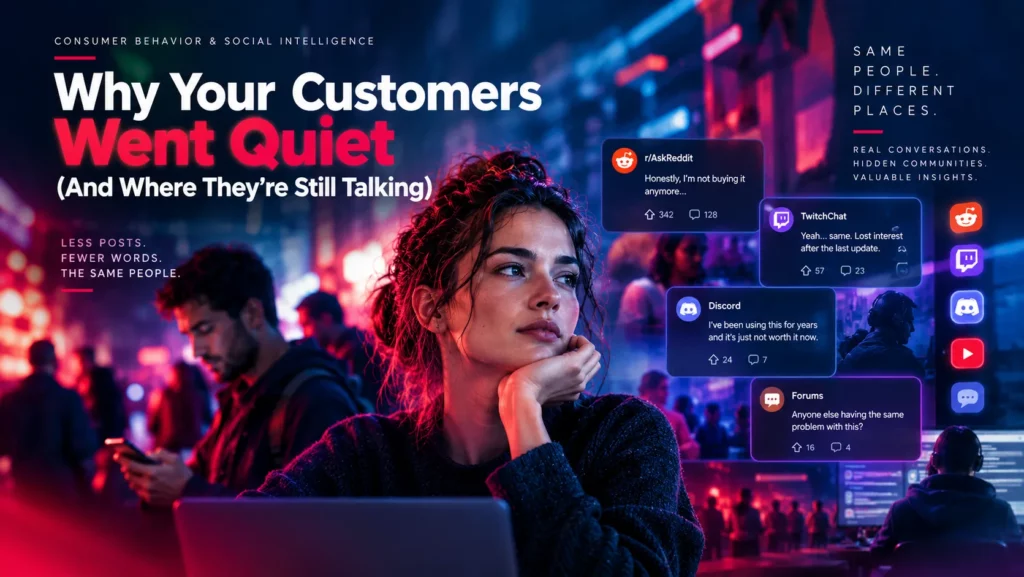
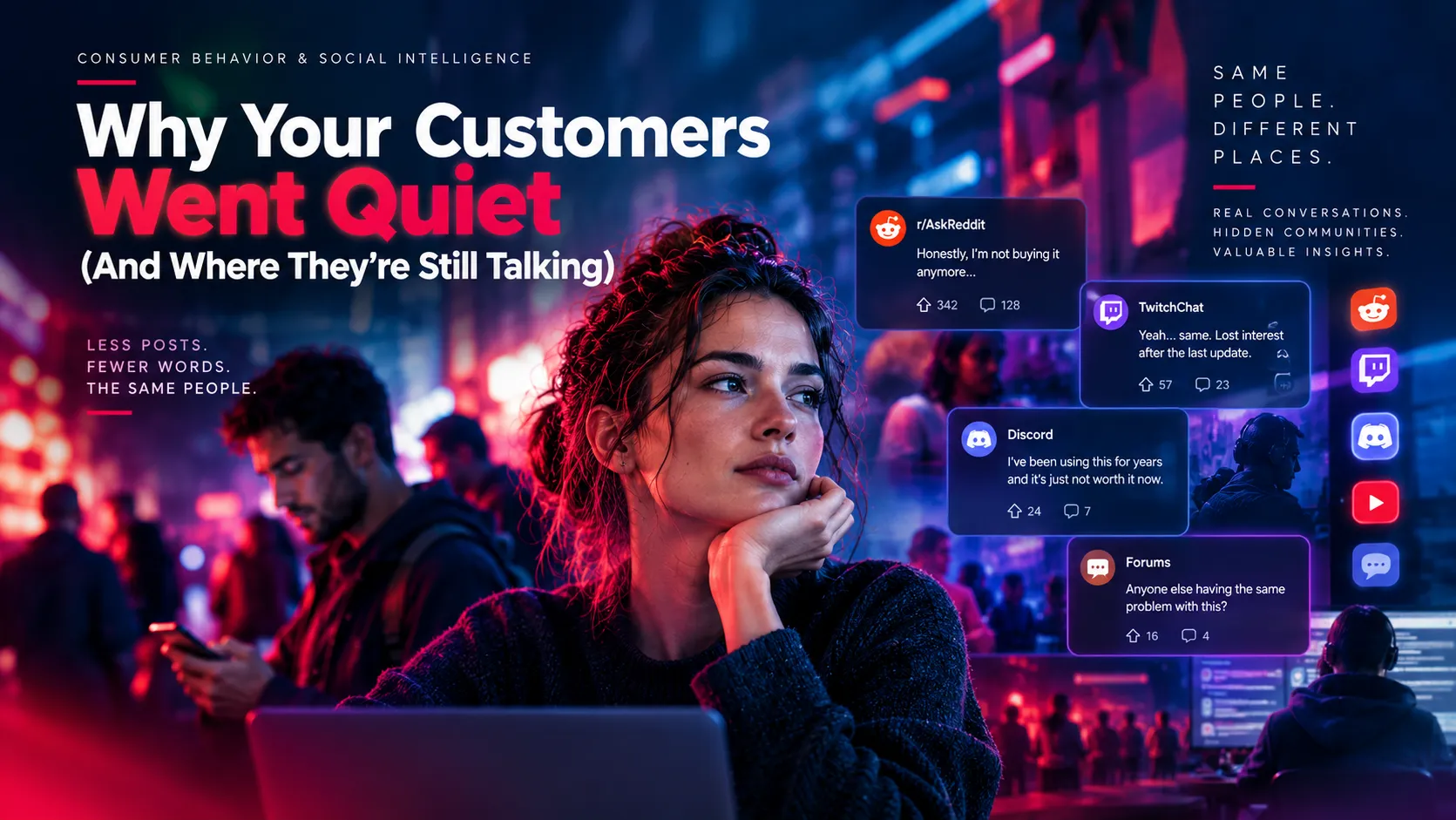
Reddit has become a default home for a lot of this. Individual subreddits build real autonomy and earned trust rather than platform-wide branding, which is exactly why a community will accept a genuine participant and freeze out a corporate account on sight. Twitch chat and niche Discord servers work the same way: real opinions, freely given, just not where a standard listening dashboard is built to look.

This Is the Gap We Built For
Most social listening tools are very good at one thing: watching the public feed. That’s a real skill. But an accelerating share of the actual signal, the honest opinions, the product complaints, the quiet loyalty and the quiet frustration, has moved somewhere that feed doesn’t reach.
That’s the gap Quiet Quotient exists to close. We track the loud, visible conversation like anyone else, but we also go looking in the places most tools were never built to check: the Reddit threads, the Twitch chats, the forums where people who’ve gone quiet in public are still saying exactly what they think. Using behavioral, psychological, and cultural intelligence, we decode what that quiet majority actually means, not just what the loud minority happens to say, and connect it back to the wider cultural and economic moment your brand sits inside. That’s what protects a reputation before a risk becomes a crisis, instead of after.
Your customers didn't stop talking. They just stopped talking where everyone else is listening.
QuietQuotient
If you want to know what they’re actually saying, let’s talk.