Louvre visitor reviews
After the Heist, the Headlines Moved On.
The Visitors Didn’t.
A Quiet Quotient Research case study in social listening: reading the Louvre’s own visitor reviews for what an automated dashboard alone would miss
On 19 October 2025, thieves walked out of the Louvre with crown jewels worth 88 million euros (2025 Louvre heist). What followed took the better part of a year. France’s national auditors had already found the museum’s renovation running badly behind schedule. Staff had already walked out once that year, in June, over overcrowding and understaffing, four months before the theft. After the heist came a suspected ticket-fraud scheme worth some 10 million euros, a steep entry-price rise for visitors from outside the EU, and in February 2026, the director’s resignation. She told the press the break-in had simply exposed what she’d already been warning about: aging infrastructure, obsolete technical systems, severe congestion. She leaves behind an 800-million-euro modernization plan, announced back in January 2025, that is still years from finished.
That’s a remarkable amount of institutional attention, almost all of it pointed at security, money, and leadership.
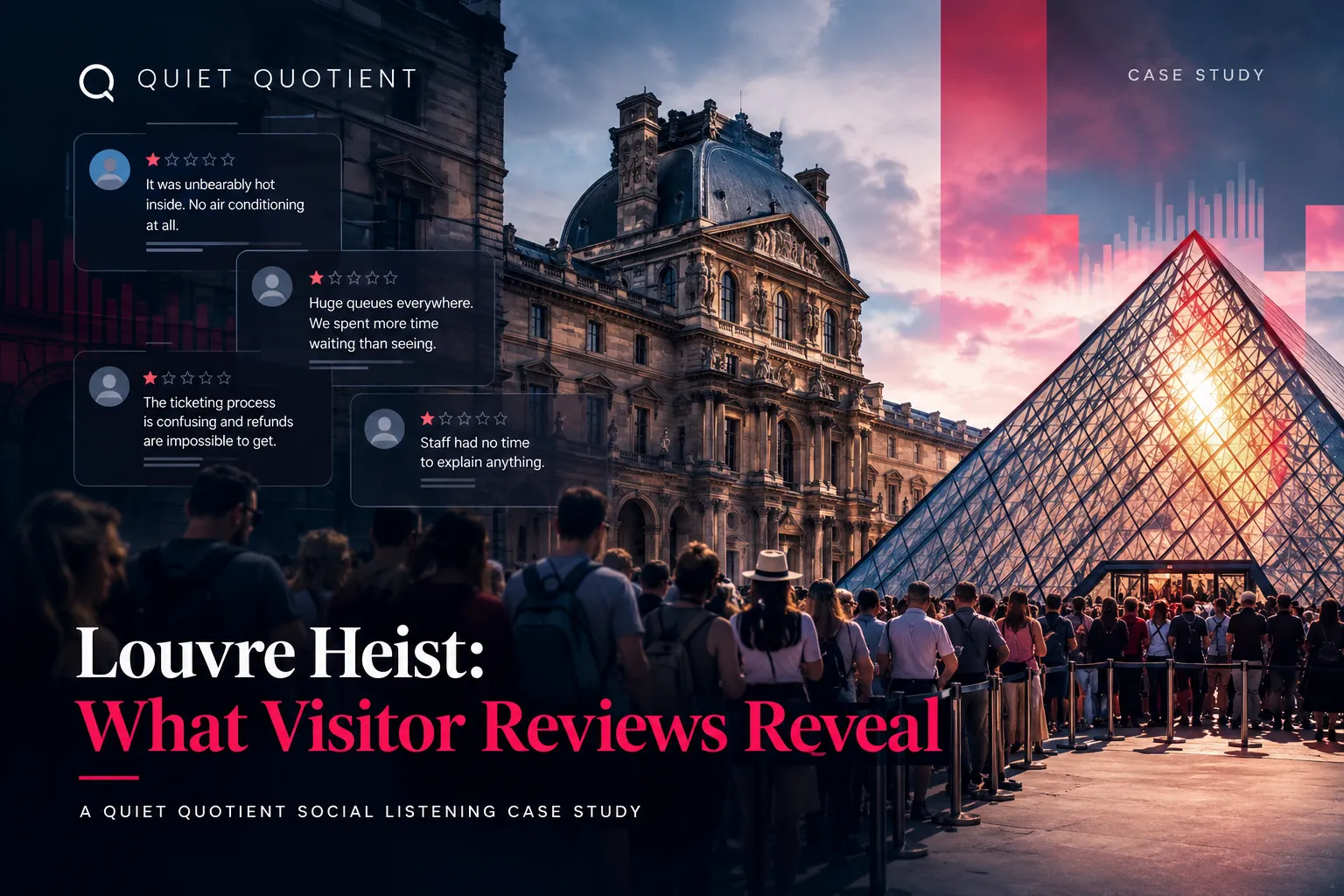
We read the Louvre’s most critical recent visitor reviews to see what people actually walking through the galleries were saying while all of this unfolded. The heist is not in them. Not once, across 38 distinct one-star reviews written after 19 October 2025. What is in them: heat, queues, confusing tickets, and staff who, by visitors’ own account, don’t have time to explain any of it. Every one of those was already true in June. The institutional story moved through theft, fraud, money, and resignation. The visitor story didn’t move at all.
What we read from Louvre visitor reviews
We started with the Louvre’s one-star TripAdvisor reviews written after 19 October 2025: the sharpest edge of visitor sentiment, where frustration tends to be most specific and most articulate. Forty reviews met that filter. Two pairs turned out to be word-for-word duplicates, most likely a platform quirk, so we removed them, leaving 38 distinct reviews.
This isn’t a claim that Louvre visitors are overwhelmingly unhappy. Most visitors never leave a review at all, and the ones who do skew toward the most frustrated. What a sample like this is good for is narrower, and for our purposes more useful: among people frustrated enough to write a one-star review in the year after the heist, what were they actually frustrated about? We’re now extending the same reading to a broader mix of star ratings, and to other major museums, as the next step.
What’s actually in the reviews
| Theme | Number of reviews |
|---|---|
| Heat / no AC | 13 |
| Crowding & queues | 13 |
| Ticketing & refunds | 9 |
| Staff conduct | 6 |
| Wayfinding & access | 6 |
| Hygiene / toilets | 5 |
| Heist / security | 0 |
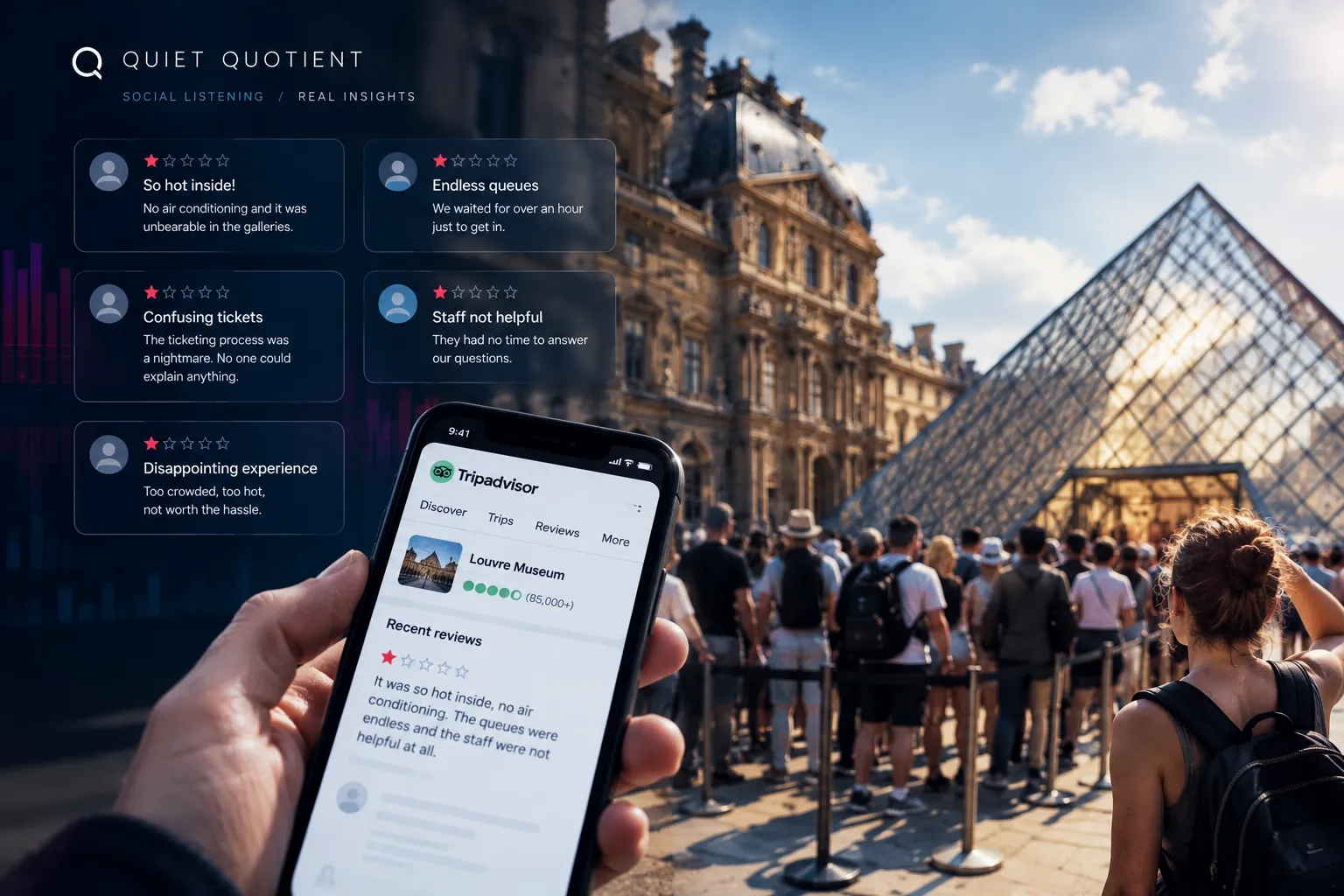
Seven themes account for nearly everything in these Louvre visitors 38 reviews, and several reviews named more than one. Heat and the lack of air conditioning led, tied with crowding and queue management. Ticketing and refund friction followed. Staff conduct, wayfinding, and hygiene trailed behind. The heist, the jewels, security, cameras: none of it appears. Not in a single one of the 38 reviews we read, all of them written after the robbery that dominated a year of headlines.
This was already on the record
This cluster didn’t come out of nowhere. In February 2026, resigning as director, Laurence des Cars told the press that the break-in had exposed problems she had already been warning about: aging infrastructure, obsolete technical systems, severe congestion. France’s national auditors had made a related point even earlier. Their report, conducted before the heist and made public on 6 November 2025, found the museum’s renovation running badly behind schedule and urged the Louvre to speed up security upgrades as a priority. That renovation, the 800-million-euro “Louvre New Renaissance” plan announced in January 2025, is explicitly meant to ease the crowding and modernize the building. It is still years from done; a dedicated room for the Mona Lisa alone isn’t due until 2031.
So the heat and the queues that visitors describe weren’t a surprise to anyone running the museum. They were on the record, in the director’s own words and in a national audit report, months before and after the robbery. What’s missing isn’t awareness. It’s the connection between that awareness and the one-star reviews piling up a few floors below it.
Two kinds of silence
Two patterns in the data point the same way. The first is in how visitors describe their own frustration: not shouting at a desk, but leaving. Several reviews describe giving up quietly rather than escalating, standing in a queue or a stifling gallery, deciding it isn’t worth the argument, and walking out. That’s a one-star review that never had a chance to become a conversation.
The second is in how the museum appears to respond, at least by visitors’ own account: unclear explanations from staff, booking and refund processes visitors describe as unresponsive. Whether or not every one of those accounts is complete, the pattern itself is telling. A complaint raised in the moment and left unanswered becomes a complaint written afterward, in public, where it can’t be resolved at all, only read by the next person deciding whether to buy a ticket.
Neither silence announces itself the way a theft does. That is, in a fairly literal sense, the whole premise of this agency: the signal most worth reading is often the one that never got loud enough to show up as a headline or a dashboard alert.
What we’d suggest, concretely
Three suggestions follow directly from what’s in the Louvre visitor reviews, not from anything more ambitious.
1. Close the loop on complaints, visibly
Several reviewers describe asking for help or a refund and hearing nothing back. A simple acknowledgment system, even a basic one, turns a silent walkout into a resolvable case instead of a public review.
2. Bridge the gap on heat, before the renovation gets there
The New Renaissance plan addresses climate control eventually, but “eventually” can be years away. Visible near-term steps, water points, fans in the worst-affected galleries, honest signage about which rooms run hot, cost little and tell visitors the museum has noticed what they’re already saying.
3. Put the ticketing explanation where the confusion happens
Refund and time-slot rules seem to be understood by staff but not reliably communicated to visitors in the moment. Clearer on-site signage and a staff script for the most common booking questions would address a theme that shows up in roughly a quarter of these reviews.
None of these require the renovation to move faster. They require someone to read what’s already being said and act on the part of it that doesn’t need 800 million euros to fix.
How we read it
This reading followed what we call the Quiet Quotient Method: five passes over the same 38 reviews, each asking a different question of them. Surface, for what’s visibly being said and how often. Identity, for who’s speaking and in what register. Tension, for where the institution’s own story and the visitor’s story pull apart. Absence, for what a reasonable person would expect to find and doesn’t. Leverage, for what’s worth acting on.
A volume-and-sentiment read of this same batch would have landed on the Surface pass alone: heat and crowding lead, the rest trail behind. That’s correct, and useful, and it’s also where most automated social listening tools stop. It has no reason to go looking for a theme that isn’t there, so a finding like “zero heist mentions in 38 reviews” doesn’t surface on its own; someone has to think to ask the question first. The same goes for noticing that the museum’s own director had already named these exact problems before the robbery, or that a quiet walkout and an unanswered refund request are the same behavior on two sides of a counter. None of that is hidden. It just needs a reader, not only a dashboard.